Source: Informed Comment

Australians in New South Wales and part of Queensland face “catastrophic” wildfires today according to government authorities.

A state of emergency has been declared and authorities are closing 500 schools today. Already 140 homes have been lost, and their proprietors are not impressed with the Australian denialist prime minister’s offer of thoughts and prayers. Scott Morrison ranted about urban leftists and the fact that there have always been bushfires in Australia. Yes, but they haven’t been this intense or frequent.

That the country’s wildfire risk has been vastly exacerbated by human beings driving cars and heating their buildings with coal and natural gas is not in question. Global temperature has increased by 1.8 degrees F. in the past century, which has contributed to greater dryness in Australia. In 2011-2016 bushfire frequency increased 40%. Graham Readfearn at the Guardian points out that controversy has erupted in Australia because the government there is the worst in the G20 on climate policies.

A new report on the G20 and climate finds that Australia’s emissions are increasing and there is no plan to rein them in. The Australian government is even more committed to Big Caol than Trump is, and is full of whiny climate change denialists. Readfearn says that the report finds that Australia is a “deforestation hot spot.”

Australia’s carbon emissions per person are among the largest in the world, between 22 and 25 tons a year. An automobile weighs two tons.
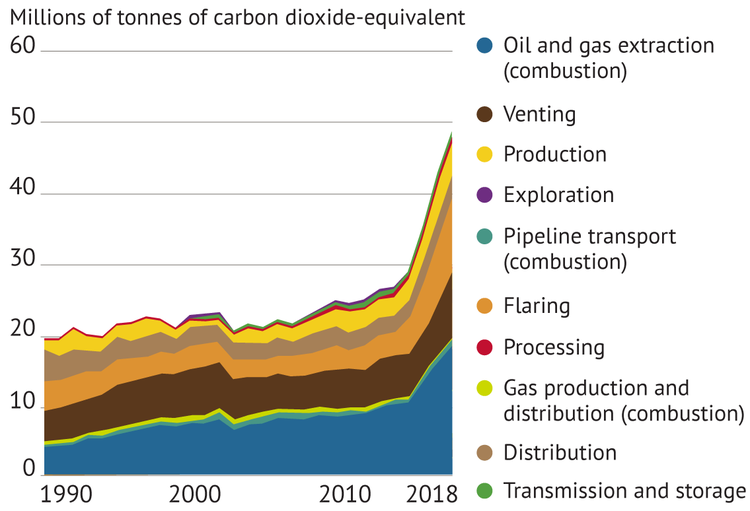
While Australia’s population of about 25 million is small and therefore its proportional contribution to global heating is also small, the country is especially vulnerable to the effects of burning fossil fuels. Drought, wildfires and sea level rise powerfully threaten its population. As a simple matter of ethics and accountability, then, Australians have a responsibility to step up.

Although their government is horrible, Australians as a people have been enthusiastic for solar energy. Last Wednesday for a brief moment renewables supplied some 50% of the electricity to the Australian grid. Graham Readfearn at the Guardian explains that most of the solar was rooftop, i.e. the government hasn’t invested or given incentives for investment in industrial-scale solar. The bad news is that the other 50% came mostly from coal, the most carbon-intensive pollutant among the fossil fuels. And ordinarily coal forms an even greater proportion of the energy making electricity.

——–

Bonus video:

Nine News Australia: “NSW shuts 500 schools as catastrophic fire conditions forecast | Nine News Australia”

Juan R. I. Cole is Richard P. Mitchell Collegiate Professor of History at the University of Michigan. For three and a half decades, he has sought to put the relationship of the West and the Muslim world in historical context, and he has written widely about Egypt, Iran, Iraq, and South Asia. His books include Muhammad: Prophet of Peace Amid the Clash of Empires; The New Arabs: How the Millennial Generation is Changing the Middle East; Engaging the Muslim World; and Napoleon’s Egypt: Invading the Middle East.


ZNetwork is funded solely through the generosity of its readers.

Donate
Donate
Leave A Reply

Subscribe

All the latest from Z, directly to your inbox.

Institute for Social and Cultural Communications, Inc. is a 501(c)3 non-profit.

Our EIN# is #22-2959506. Your donation is tax-deductible to the extent allowable by law.

We do not accept funding from advertising or corporate sponsors.  We rely on donors like you to do our work.

ZNetwork: Left News, Analysis, Vision & Strategy

Subscribe

All the latest from Z, directly to your inbox.

THE WIND CRIES FREEDOM

The Wind Cries Freedom, the new book from Z co-founder Michael Albert, is a sweeping oral history of a future American revolution.

Through thirty interconnected chapters, it draws out the strategies, failures, turning points, and hard-won wisdom of a movement that called itself the Revolutionary Participatory Society. These are not the polished memoirs of politicians: they are the unfiltered accounts of people who organized in neighborhoods, hospitals, universities, stadiums, courthouses, and places of worship, and kept a shared vision alive through cynicism and exhaustion.

The result is speculative political fiction that reads like history: messy, human, and quietly hopeful in the way that only real experience and long thought can produce.

Get your copy and peruse more features on the book’s website below.

“Read it, argue with it, but don’t look away. The future it recalls is one we must still fight to deserve.”

Yanis Varoufakis

“The most unusual and intriguing combination of prophecy, manifesto, and movement building manual that I have ever encountered.”

Bill Fletcher Junior

“This work fills a huge gap in our social movement literature.”

Cynthia Peters

You've just read your article on Z this month.

DOES Z'S SURVIVAL MATTER?

You keep coming back for a reason: serious political analysis, movement reporting, and debate beyond the priorities of corporate media. Today, Z is in a precarious financial position. If Z is part of how you understand the world, help keep it going. The readers who give monthly are the reason this work survives between fundraisers.

Z is in a precarious financial position. If it’s part of how you understand the world, help keep it going.

Number of donors710
Our goal1,000

Sustainers at $9/month or more receive the digital Z Magazine.

Already a sustainer? Click here and we won’t ask again. Thank you!

Your reading count is stored only in your browser and is never sent to us.

Sound is muted by default.  Tap 🔊 for the full experience

CRITICAL ACTION

Critical Action is a longtime friend of Z and a music and storytelling project grounded in liberation, solidarity, and resistance to authoritarian power. Through music, narrative, and multimedia, the project engages the same political realities and movement traditions that guide and motivate Z’s work.

If this project resonates with you, you can learn more about it and find ways to support the work using the link below.

Z is in the most precarious financial position in its history.

Z is a place to think beyond the limits of the present.

For decades, Z has brought together political analysis, movement reporting, debate, and visions of a different future from writers and activists around the world. That work is more than journalism. It is movement infrastructure: movements need places to develop ideas, test arguments, learn from experience, and imagine what comes next.

In the first two days of this fundraiser, 19 donors and 8 new monthly sustainers stepped up. Help us reach 1,000 donors who keep Z independent, for everyone.

For decades, Z has published the analysis, debate, and visions movements need, free of paywalls, ads, and billionaire owners. If that work should continue, Z needs your support now.

Number of donors710
Our goal1,000

Sustainers at $9/month or more receive the digital Z Magazine.

Subscribe

Join the Z Community – receive event invites, announcements, a Weekly Digest, and opportunities to engage.

Exit mobile version

