

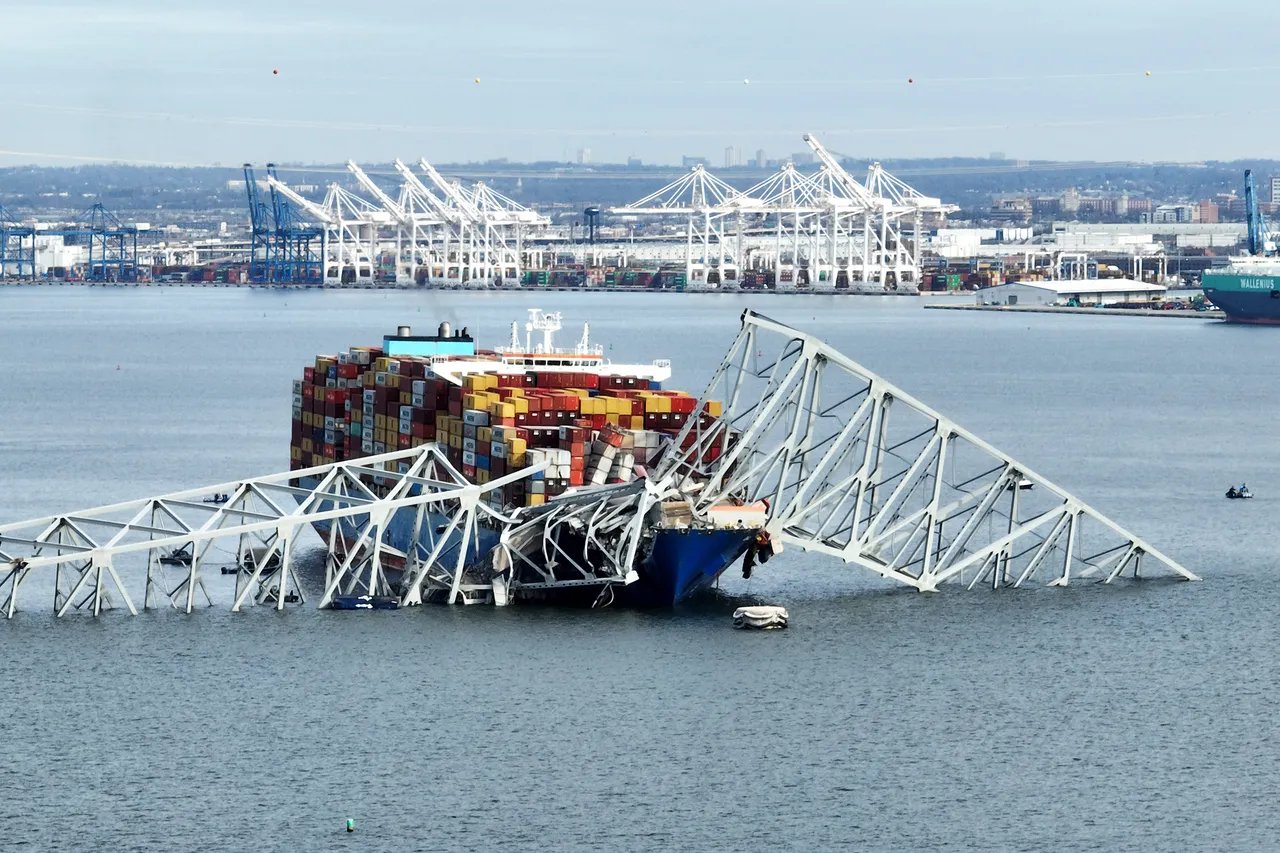
The company that chartered the cargo ship that destroyed the Francis Scott Key Bridge in Baltimore was recently sanctioned by regulators for blocking its employees from directly reporting safety concerns to the US Coast Guard — in violation of a seaman whistleblower protection law, according to regulatory filings reviewed by the Lever.
Eight months before a Maersk Line Limited–chartered cargo ship crashed into the Baltimore bridge, likely killing six people and injuring others, the Labor Department sanctioned the shipping conglomerate for retaliating against an employee who reported unsafe working conditions aboard a Maersk-operated boat. In its order, the department found that Maersk had “a policy that requires employees to first report their concerns to [Maersk] . . . prior to reporting it to the [Coast Guard] or other authorities.”
Federal regulators at the Occupational Safety and Health Administration, which operates under the Labor Department, called the policy “repugnant” and a “reprehensible and an egregious violation of the rights of employees,” which “chills them from contacting the [Coast Guard] or other authorities without contacting the company first.”
Maersk’s reporting policy was approved by company executives, federal regulators found in their investigation into the incident.
“[Maersk’s] Vice President of Labor Relations, admits that this Reporting Policy requires seamen to report safety concerns to the company and allow it time to abate the conditions before reporting to the [Coast Guard] or other regulatory agencies,” Labor Department investigators said in their report.
During their investigation into Maersk, federal officials said there was “reasonable cause to believe” that the company’s policy violated the Seaman’s Protection Act, which protects maritime workers who speak out about unsafe working conditions. Officials ordered the company to reinstate the employee and pay over $700,000 in damages and back wages. They also demanded that Maersk revise its policy to allow seamen to contact the Coast Guard about safety concerns before notifying the company.
The fired employee was a chief mate on the Safmarine Mafadi, a Maersk-operated vessel, who also served as a relief captain when needed. The seaman reported unrepaired leaks, unpermitted alcohol consumption onboard, inoperable lifeboats, faulty emergency fire suppression equipment, and other issues.
Before he was fired, the employee was disciplined for not properly maintaining the logbook and failing to properly follow orders. The fired employee told federal regulators that he believed these disciplinary actions were “retaliation for reporting alcohol consumption on board the vessel.”
Maersk did not respond to Lever questions about the Labor Department’s findings and its previous policy on workplace safety reporting ahead of publication.
In a comment to other news outlets, Maersk stated: “We are horrified by what has happened in Baltimore, and our thoughts are with all of those affected. We can confirm that the container vessel ‘DALI’, operated by charter vessel company Synergy Group, is time chartered by Maersk and is carrying Maersk customers’ cargo. No Maersk crew and personnel were onboard the vessel. We are closely following the investigations conducted by authorities and Synergy, and we will do our utmost to keep our customers informed.”
Whistleblower Protection
The Seaman’s Protection Act was enacted in 1984 to protect maritime workers who reported statutory violations to the Coast Guard from company retaliation. These employees had been left out of other whistleblower laws at the time. In 2010, the legislation was amended to also safeguard employees who refused to perform certain duties due to fears of personal injury.
Enforced by the Occupational Safety and Health Administration, companies that violate the Seaman’s Protection Act can be subject to hundreds of thousands of dollars in fines. The Coast Guard also encourages employees to “report any hazardous condition before it results in a costly mishap.”
Despite the law explicitly protecting maritime employees from workplace abuses including whistleblower retaliation, experts say there have been relatively few whistleblower complaints. In 2017, a case involving the Seaman’s Protection Act made it to the Supreme Court seeking to protect a New York harbor worker, a “persistent safety advocate,” who had been fired after reporting dangerous conditions, though the court declined to hear the case.
Many maritime employers have a similar policy that prevents employees from directly contacting the Coast Guard or other regulatory agencies, according to Eric Rhine, a lawyer specializing in maritime injuries, aviation accident claims, and other issues at the Spagnoletti Law Firm.
In a blog post, Rhine highlighted a previous whistleblower retaliation case that found it was “‘standard business practice’ for employers to prohibit any direct contact by employees with government regulatory bodies.”
Rhine also highlighted that maritime employees, who face many work hazards, have a right to report unsafe conditions aboard their vessels to federal regulators.
“Sometimes accidents occur when they could have been avoided if proper and reasonable care was taken by those responsible for safe working conditions,” Rhine wrote. “These accidents can leave employees with lasting impairment that prevents them from ever working again. Of course, even worse, they can be deadly.”
Total Collapse
The vessel that crashed into the Baltimore bridge, Dali, was chartered by Maersk and operated by Synergy Marine Group, a ship management company based in Singapore. The ship had a crew of twenty-two foreign workers from India. The boat is owned by Grace Ocean Private and was headed to Sri Lanka.
Maersk, which is headquartered in Copenhagen, is one of the world’s largest shipping companies, reporting more than $51 billion in revenue in 2023. The company operates in 130 countries and employs one hundred thousand workers, according to its annual report. As of December 2023, Maersk owned 310 ships and was chartering 362, which they say is one of the world’s largest container shipping fleets.
Since 2021, Maersk has spent $2.7 million lobbying Congress and federal regulators on workers compensation, as well as port congestion and infrastructure issues, among other concerns, regulatory filings show.
Since last summer, Maersk has been battling the International Longshoremen’s Association — a labor union that represents sixty-five thousand maritime workers, including Maersk employees — over labor unrest at a port in Alabama.
In August 2023, APM Terminals, a division of Maersk, sued the union, claiming that workers at its Mobile, Alabama port were on strike illegally during an active contract. The court case is ongoing, and documents filed by the union in March allege that the company illegally suspended six workers for “raising a concern about a safety issue at the job site.”
As of publication time, rescuers have suspended the search for six missing construction workers who were working on the Baltimore bridge at the time of the collapse. The workers are presumed dead, officials said. One body was reportedly recovered from the river on Tuesday.
ZNetwork is funded solely through the generosity of its readers.
Donate




