

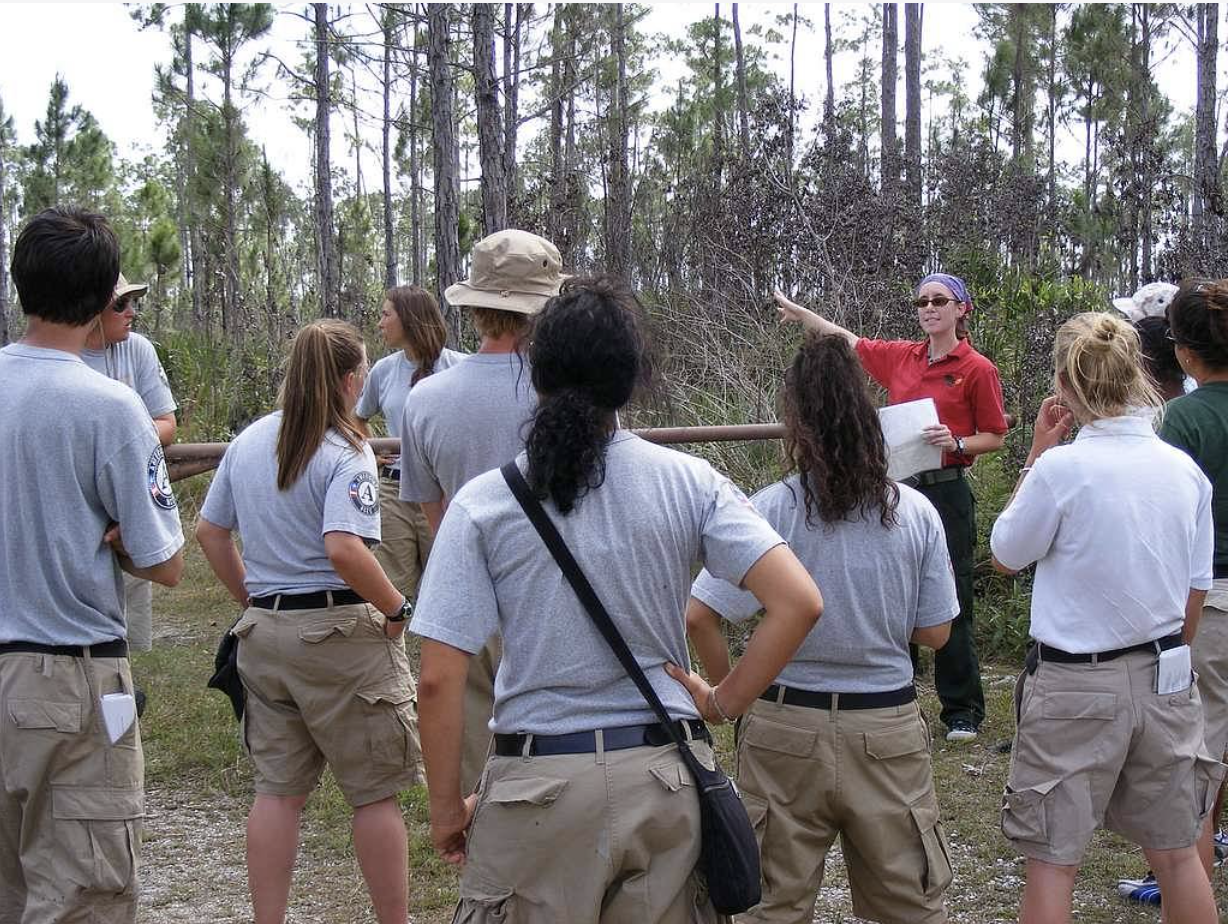
After devastating fires tore through Los Angeles in January, a crew of more than 300 young people showed up to help, many of them members of the national service program AmeriCorps. Among them was Julian Nava-Cortez, who traveled from northern California to assist survivors at a disaster recovery center near Altadena, where the Eaton Fire had nearly destroyed the entire neighborhood. People arrived in tears, overwhelmed and angry, he said.
“We were the first faces that they’d see,” said Nava-Cortez, a 23-year-old member of the California Emergency Response Corps, one of two AmeriCorps programs that sent 74 workers to the fires. He guided people to the resources they needed to secure emergency housing, navigate insurance claims, and go through the process of debris removal. He sometimes worked 11-hour, emotionally draining shifts, listening to stories of what survivors had lost. What kept him going was how grateful people were for his help.
Volunteers like Nava-Cortez have helped 47,000 households affected by the fires, according to California Volunteers, the state service commission under the governor’s office. But in late April, Nava-Cortez and his team at the California Emergency Response Corps were suddenly placed on leave. Another program helping with the recovery in L.A., the California AmeriCorps Disaster Team, also abruptly shut down as a result of cuts to AmeriCorps.
Both were casualties of Elon Musk’s Department of Government Efficiency, known as DOGE, which has gutted the 30-year-old national service agency in a matter of weeks. In April, AmeriCorps placed 85 percent of its 500 staff on leave and canceled nearly $400 million in grants out of a $1 billion budget. The move effectively ended the service of an estimated 32,000 AmeriCorps workers across the country. The agency puts more than 200,000 people, young and old, in service roles every year.
Across California, the cuts meant that about a dozen programs working on climate change, conservation, and disaster response were forced to “reduce service projects, limit recruitment, and scale back support in high-need communities,” said Joyia Emard, the communications deputy director at California Volunteers.
That work is just a tiny slice of what AmeriCorps does across the country. DOGE’s attempt to dismantle the agency has unraveled all kinds of programs — tutoring centers in elementary schools, efforts to reduce poverty, and trail maintenance crews. If you saw a team of young people running an after-school program, helping out in a soup kitchen, or cleaning up after a hurricane, there’s a good chance it was connected to AmeriCorps in some way.
Most people “didn’t realize the degree to which it was everywhere and was doing so much good,” said Dana Fisher, a professor at American University’s School of International Service who studies how service programs can help communities respond to and recover from disasters, as well as prepare for future ones. Following floods, hurricanes, and tornadoes, AmeriCorps volunteers have helped manage donation centers, clear out debris, and “muck and gut” buildings, often in coordination with other agencies and local nonprofits.
Fisher calls AmeriCorps the “connective tissue” that makes it easier to coordinate after disasters, thanks to its connections across the country. The agency boasts that it is “often the first to respond and the last to leave,” with members sometimes working months or years after a disaster strikes.
“This will be disastrous to communities,” Fisher said about the Trump administration’s gutting the program. “And the thing that’s really unfortunate is we won’t feel it until after disaster hits.”
Disaster preparedness is being weakened across the federal government, even as heat waves, flooding, and other extreme weather are becoming more extreme as the climate warms. The National Oceanic and Atmospheric Administration is operating at such diminished levels that experts are warning hurricane forecasts will be less accurate ahead of what’s predicted to be a brutal hurricane season. President Donald Trump has repeatedly floated the idea of eliminating the Federal Emergency Management Agency, which handles relief and recovery after extreme weather.
The loss of staffing and programs at AmeriCorps is one more blow to the country’s ability to respond to and recover from disasters. In mid-April, AmeriCorps abruptly pulled teams of workers with its National Civilian Community Corps off their jobs rebuilding homes destroyed in storms, distributing supplies for hurricane recovery, and more. “People were very upset, very sad, and a lot of people just did not know what they were going to do, because this was our plan for our year,” said Rachel Suber, a 22-year-old member of FEMA Corps, an AmeriCorps NCCC program. Suber had been helping Pennsylvanians rebuild after Hurricane Debby last year.
At the end of April, two dozen states, including California, sued the Trump administration over the cuts to AmeriCorps, alleging that DOGE illegally gutted an agency that Congress created and funded. A separate lawsuit filed last week by AmeriCorps grant recipients is also trying to block the cuts. Nava-Cortez was told that the outcome of his program is up to the courts, so he’s waiting until the end of the month to see what happens. He’d been hoping to move to San Jose for school after his term ended this summer, but now he’s not even sure he can cover this month’s rent.
It’s a long tradition in the United States to provide low-paying service jobs for young people. “Your pay will be low; the conditions of your labor will often be difficult,” President Lyndon B. Johnson said in 1964, when the first cohort of volunteers were sworn in with VISTA, a service program to alleviate poverty. “But you will have the satisfaction of leading a great national effort.” Congress established AmeriCorps in 1993 under President Bill Clinton, folding in VISTA and NCCC, and continued to expand the program with bipartisan support.
AmeriCorps had expanded its environmental work by almost $160 million in recent years, Michael Smith, the former CEO of AmeriCorps, told Grist last year. Under the Biden administration, climate service work around the country was collected under the short-lived American Climate Corps, which was quietly ended in January ahead of Trump’s inauguration.
After Trump took office, some programs had the opportunity to modify any wording in their grants that conflicted with the president’s executive orders, such as removing language about diversity, equity, and inclusion, or swapping the word “conservation” for “climate change,” said Mary Ellen Sprenkel, president and CEO of The Corps Network, a national association of service programs. She was told that some state commissions that distribute AmeriCorps funding did not allow their grant recipients the chance to rewrite their grants, which may explain why those programs have been hit especially hard by DOGE.
And there may be more cuts coming. “There are a lot of signs that the Trump administration is not done yet with AmeriCorps,” Fisher said. In more recent years, some Republicans have argued that AmeriCorps misspent money and that it had repeatedly failed to provide proper statements for audits. Yet a number of Republicans in Congress support AmeriCorps because of the impact it’s had in their districts, Sprenkel said. Republican Senator Bill Cassidy of Louisiana, for example, posted on social media that he objected to cutting AmeriCorps grants that support veterans and provide “crucial support after hurricanes.”
AmeriCorps workers receive what the agency calls a “modest living allowance” to pay for their basic expenses. The amount varies by program: VISTA members typically are paid about $2,000 a month, while NCCC and FEMA Corps members receive about $400 a month plus housing and money for food. In terms of bang for its buck, AmeriCorps pays for itself. Every dollar invested in environmental work generated many in return, according to an assessment from the agency’s Office of Research and Evaluation from December. The Montana Conservation Corps, for example, earned returns as high as $35.84 for each dollar spent.
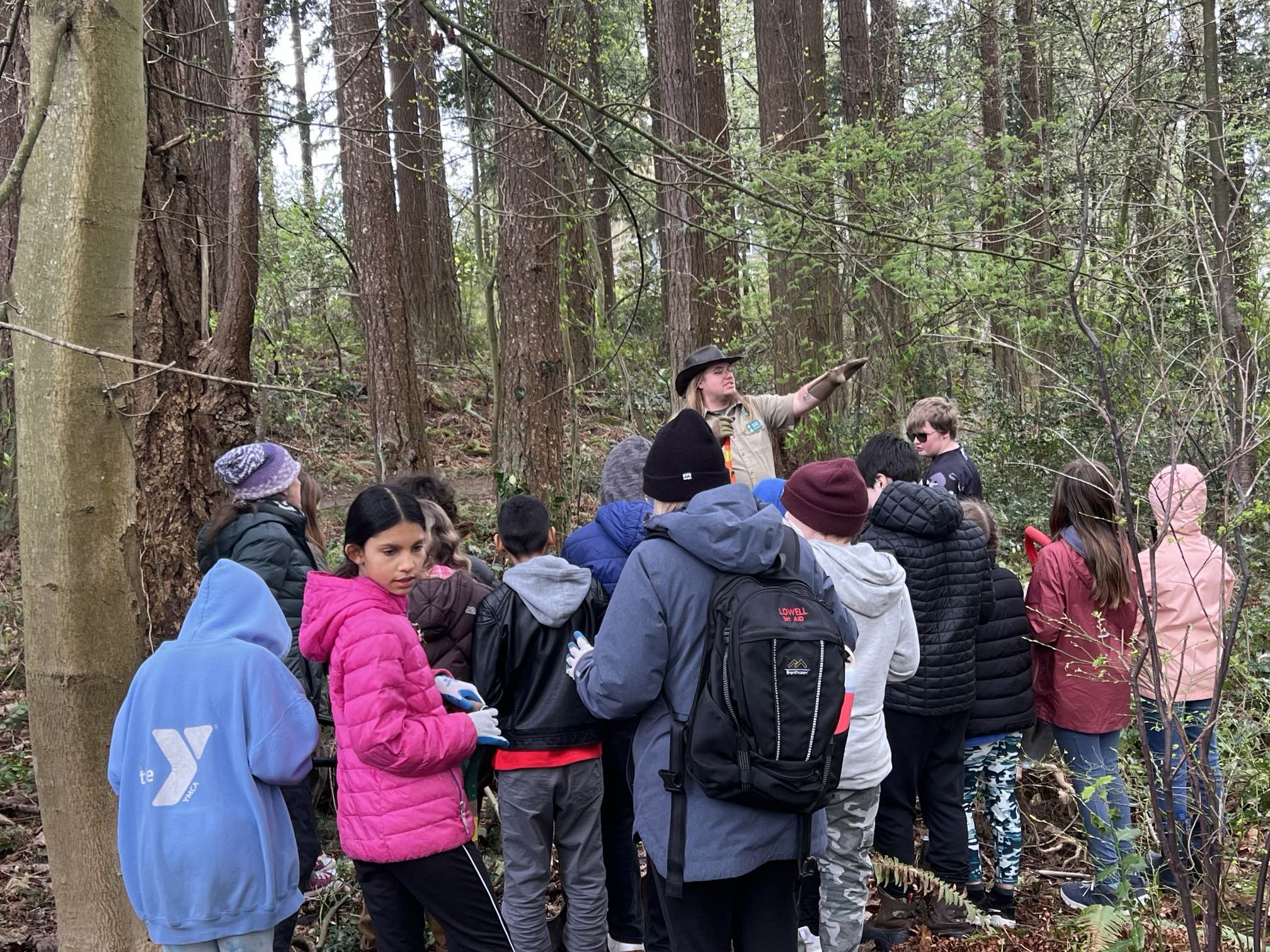
“If it’s a financial decision to close AmeriCorps, then it doesn’t really make sense,” said Sky Hawk Bressette, 26, who had been working in the parks department for Bellingham, Washington. As part of the Washington Service Corps, he and his colleague taught 5th graders about native plants and coordinated volunteers who planted thousands of trees and removed invasive species — but much of that work is now on pause after funding cuts. “It’s a huge loss for the 1,000 students that we work with in our city alone, and just multiply that by every city that uses AmeriCorps around the country,” Bressette said.

Allison Greener Grant
Most organizations within The Corps Network rely on AmeriCorps for somewhere between 15 and 50 percent of their budget, according to Bobby Tillett, director of member services at the network. As they try to scrape together funding and continue the work they can, he said, they’re unsure what to tell the people accepted for summer programs that are supposed to start in June.
“All of those programs were part of this amazing network of service that basically gave nobody high-paying jobs, but gave so much back to communities,” Fisher said. “And all of that is being lost.”
Zoya Teirstein contributed reporting to this story.
ZNetwork is funded solely through the generosity of its readers.
Donate




