


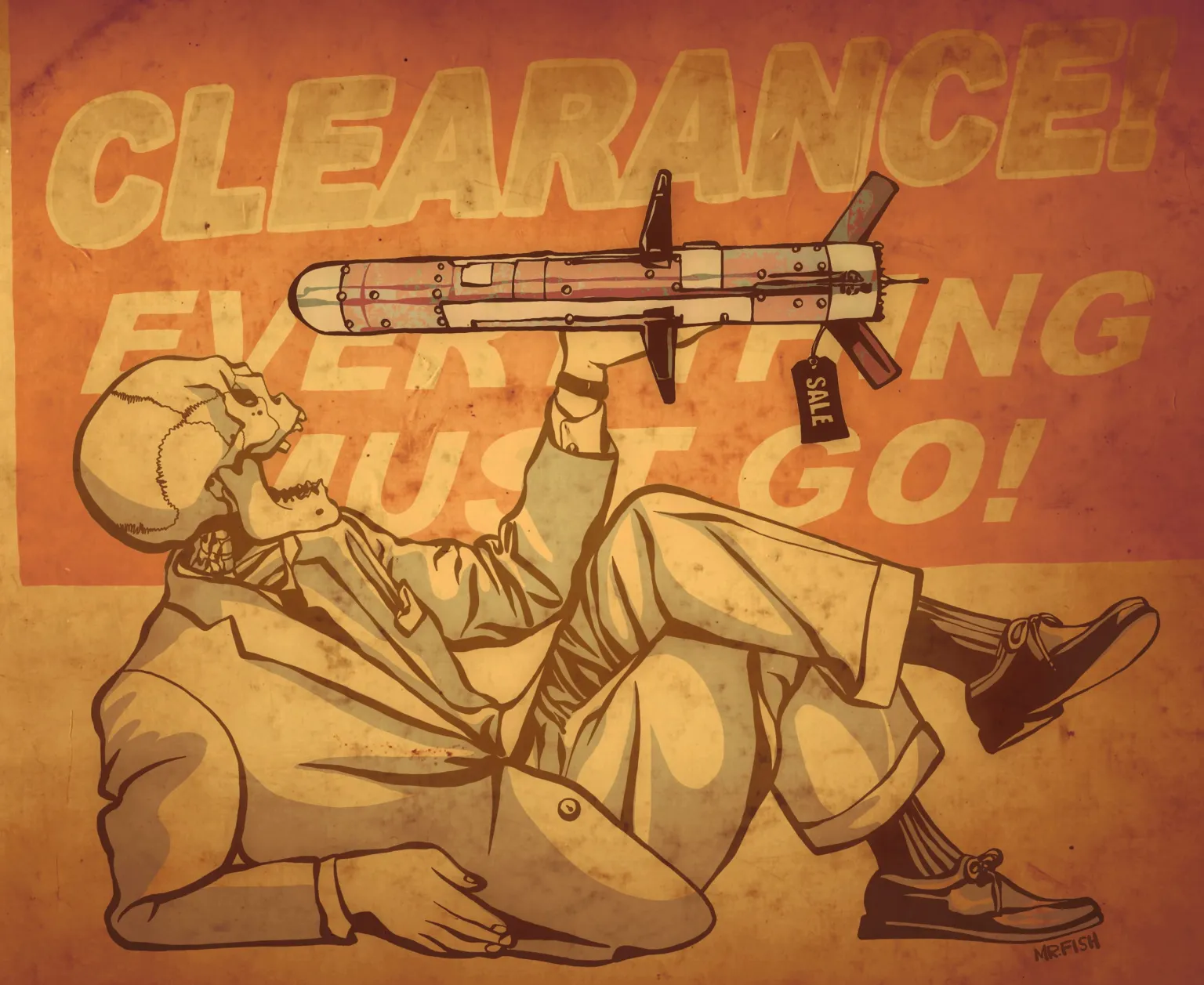
You may have heard that the U.S. Congress is finally doing the decent, moral, liberal, democratic, Democratic thing and aiding Ukraine.
You may believe, as pretty much everyone I ask tells me, that there was only one other choice available, namely “letting Putin win.”
You may agree with me that the Russian government and its leader — like every government I’ve ever heard of — have done horrendous things, that invading a country militarily is one of the worst things that can ever be done (with the possible exceptions of invading Libya or Yemen or Syria or Iraq or Afghanistan or anywhere in Latin America, but still), and that rewarding a military invasion is a terrible precedent that could encourage more military invasions (with the possible exception of keeping those bases in Iraq or Syria, or selling more weapons to Saudi Arabia, or marketing that empty beachfront property in Gaza — and who the heck is Niger to tell U.S. troops to leave Niger? I mean come ON! — but still). I’m with you. Between (A) send more unimaginably huge piles of money that materializes out of nowhere and (B) allow a military invasion to succeed, I’m for A.
But please consider five slight complications to this simple tale.
- What the U.S. Congress just did is send huge piles of money that comes out of urgent non-optional crises like climate, eco-collapse, disease, poverty, and homelessness, mostly to U.S. weapons dealers, damaging — yes damaging — the U.S. economy, in order to send mountains of weapons to the war in Ukraine, the war in Gaza, and a yet-to-be-ginned-up war in Asia. No matter how much you support the war in Ukraine, unless you also support providing enough weapons to murder every last person in Gaza and the West Bank, and in addition support building up toward a catastrophic war with China, you ought to at least have mixed emotions here.
- Countless experts around the globe believe that the war in Ukraine has placed the world closer than ever before to nuclear apocalypse. I picture two cockroaches endowed with the power of speech meeting each other as they crawl over the ruins of the de-personed Earth. One says “Well, at least they stood up to Putin,” and the other simultaneously, “Well, at least they stood up to NATO.” Upon which the war that eliminates all cockroaches is begun. But where, while we still breathe, are our priorities? Is smashing every aspiration of the criminal Russian government (which I’m all in favor of) in order to uphold a rules-based order in which you can freely fuel a sadistic genocide in Palestine (which I’m not so much in favor of) a higher priority than preserving life? And if so, why are you not over there killing Russians yourself, instead of over here cheering for Congress buying more weapons?
- I’ll leave the option of Russia “winning” to point #4 below. But what is the other option exactly, the one that has been so correctly and nobly chosen? It’s clearly not Russia losing. Nobody even pretends it is. It’s clearly just continuing the endless slaughter with no desirable outcome for either side anywhere on the horizon. Yet more Ukrainians can go on dying, and Russians can go on dying in larger numbers, but that can’t continue until everyone’s dead, not without nuclear escalation — possibly following a French escalation that U.S. media outlets might begin by opposing. So what is it that you think you’ve chosen? Choosing “Not Putin Winning” is great, like choosing “The Candidate Who Isn’t Trump.” Who could disagree? But what if there were an option superior to “Putin winning” and also superior to endless war that risks apocalypse?
- It helps to face for a moment the complex story of Ukraine, to come to grips with some facts that are as well established as is the illegal, immoral, murderous Russian invasion of 2022, such as that U.S. and foreign officials (including the current CIA director) warned for decades that NATO expansion would create this war — and some (such as the authors of a RAND Corporation report) advocated for just the provocative steps that were taken in order to create this war, that the U.S. supported a coup in Ukraine in 2014 that overthrew a government pursuing neutrality, that the coup government threated the rights of Russian speakers, that the people of Crimea heavily favored returning to Russia, that Ukraine waged a war on its eastern provinces for 8 years, that Ukraine and its Western partners never intended to and never did honor the Minsk II agreements which could have meant lasting peace, that Russia and Ukraine were ready to agree to peace 1 month into the Russian invasion at talks in Turkey where they agreed on Russian withdrawal and a Ukrainian commitment not to join NATO or allow NATO bases in Ukraine — until the U.S. and UK said No, as they have continued to say in the face of horrific suffering, not to mention in the face of nearly identical peace proposals from African leaders, Latin American presidents, the Pope, the Chinese government, and scholars and activists across the globe. This history does not erase, but does complicate, the tale of angelic Ukrainian innocence against evil Russian outlaws.
Crimea was Russian or Soviet from 1783 to 1991. No election should ever be held with armed troops anywhere within sight. And it’s no simple matter to say that Crimea should hold a new referendum, since people have left and entered. But nobody seriously doubts that any fair election in 2014 or at any time since would have resulted in a majority choosing Russia. The Donbas needed some degree of independence before Minsk II and still does. It needs it free of militarized borders and chest-thumping empires. Some consideration should be given to whether the people who live there “win” or “lose” — that is, how their lives look going forward. For them and for the world, peace is preferable to war, and peace is prevented by endless weapons and endless opposition to negotiations.
- Prior to this recent “aid” package, 62% of U.S. federal discretionary spending was going into militarism. Now it’s more. The other 38% and shrinking has to cover environment, education, health, housing, transportation, agriculture, and everything else. Normalizing endless massive warmaking, just because it’s non-U.S. troops dying, is a path to disaster. To begin considering a different course, here are a few eye-opening reads:
- Primer on Foreign Policy
- Action for Ukraine and the World
- The EU Can Only Survive as a Peace Project and Not as a NATO Subsidiary
- WBW Advisory Board Member Matt Hoh Addresses United Nations
- Are We Stumbling Into World War III in Ukraine?
- Attacking Pope, Militarists Target Ukrainian Peace Formula of President Zelenskyy
- Putin’s Draft Treaty Between Russia and Ukraine Did Exist
- Letter on Ukraine from Latin America to the World
- Message from Ukraine to Europe
- After Two Years of War in Ukraine, It’s Time for Peace
- A World BEYOND War


David Swanson is an author, activist, journalist, and radio host. He is executive director of World BEYOND War and campaign coordinator for RootsAction.org. Swanson’s books include War Is A Lie and When the World Outlawed War. He blogs at DavidSwanson.org and WarIsACrime.org. He hosts Talk World Radio. He is a Nobel Peace Prize Nominee.
ZNetwork is funded solely through the generosity of its readers.
Donate




