

Noam Chomsky is a renowned linguist who is perhaps better known for his radical critique of America’s economic and foreign policies. According to the Chicago Tribune, he’s "the most often cited living author. Among intellectual luminaries of all eras, Chomsky placed eighth, just behind Plato and Sigmund Freud." I interviewed him on January 26, for the Industrial Worker, the IWW’s newspaper. It’s printed here with their permission.
HOCHSCHARTNER: You wrote that Obama "broke ground" in supporting the Honduras coup. Explain what you meant.
CHOMSKY: I don’t remember putting it that way. In earlier years, the U.S. supported coups outright or carried them out for that matter. In fact, in 2004, they carried out the coup in Haiti and in 2002 openly supported the coup in Venezuela. Obama did it indirectly. He joined the Organization of American States in criticizing the coup. He wouldn’t call it a military coup. He kind of dragged his feet.
Almost every country, even in Europe, withdrew their ambassadors. The U.S. didn’t. The U.S., of course, has enormous influence in Honduras. The military’s trained by the United States. They have very close connections, but they didn’t do much at first. They didn’t try to use their influence. Then, as it proceeded, the Obama administration ended up essentially supporting the coup regime. The U.S. was almost the only country that recognized the elections under military rule. It was the usual support for right-wing military coups, but in a softer way than usual. That’s partly a reflection of the change in power relations.
What do you mean by that?
Latin America’s become a lot more independent. Take Brazil. Forty-five years ago the Kennedy administration didn’t like the government in Brazil. It was a kind of mildly social democratic government not very different from [current] President Lula’s. So they organized a military coup and established a neo-Nazi style national security state. That was the norm, one country after another through the 1980s. It was a monstrosity. Latin America, finally, after 500 years, is moving towards integration for the first time and paying a little attention—in some cases, like Bolivia, a lot of attention—to the needs of the poor majority, which is new. That’s made the continent a little more independent of the U.S. The U.S. was kicked out of its last military base in Ecuador in September 2009. It now has seven new ones in Colombia, which is the last holdout.
In Citizens United v. the Federal Election Commission, the Supreme Court gave corporations free rein to spend as much money they wanted on elections. What effect will have?
It’s a significant step beyond what was already intolerable. Elections are pretty much bought. You can predict the victor in an election by who’s outspending whom. And the funding, of course, mostly traces back to corporations in one way or another. But until now they had to do it in kind of indirect, devious ways. The Supreme Court has now said, "Look, you can buy them off directly if you like. You can run ads in favor of a particular candidate with corporate money." That’s even more extreme than campaign funding.
The mainstream media’s tried to balance what’s going to be a huge influx of corporate spending by saying, "Well, the unions are going to be able to do it too." But the idea that the unions are going to raise anything comparable…
Not only that, but, even with all of their flaws, unions, basically, are democratic. Its workers who get together and are supposed to be able to make decisions. That’s not what a corporation is. A century ago, corporations were identified by the courts with management. Management is the corporations. For this campaign spending, management doesn’t even have to consult with shareholders. They’re pure tyrannies. Labor unions are supposed to, at least, work for the benefit of their members. Corporations are required by law to work only for profit and for material gain. They’re not allowed to do anything else. How can you compare them? It’s just a joke.
After the Republican victory in Massachusetts, Democrats have said they don’t think they have the votes for health care. What’s your take on the situation?
The election in Massachusetts was interesting. The statistics came out on the voting. Brown won because of very strong support in the wealthy suburbs and because of pretty much apathy in the poorer, urban, Democratic areas. So the rich want even more. Nothing’s ever enough. The population is saying, "Look, we don’t like the way you’re giving everything away to the rich." So they just mostly stayed home.
Returning to health care, a majority of the population is opposed to Obama’s health-care program. That’s what the headlines say and that’s true. But if you look at the polls, they’re mostly opposed to it because it doesn’t go far enough. He gave away everything. They gave away the public option, which there’s a strong majority for. They gave away the Medicare buy in at 55. Again, very strong majority. He made a deal with the drug companies saying, "Yeah, we’ll continue the policy of not negotiating with you." There’s about 85 percent opposition to that.
The public wants cost-cutting, which makes sense. The program’s out of sight. But you can’t have cost-cutting when you hand it over to private insurance companies that are unregulated. You can cut around the edges somewhere, but you can’t deal with the essence of the problem.
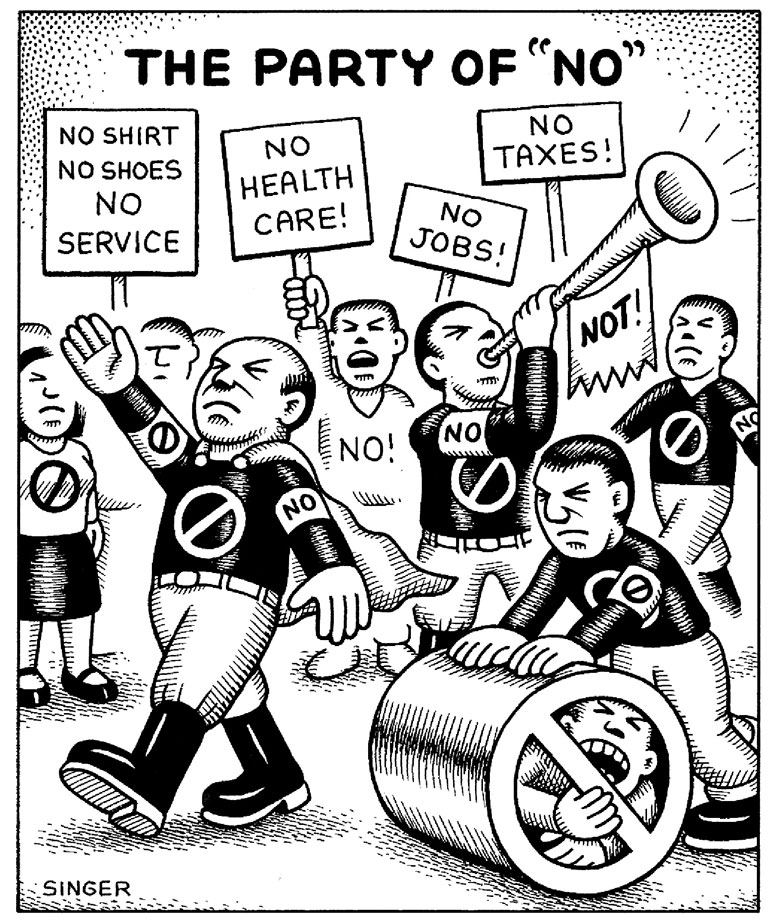
On the right, there’s been a lot of talk about the tea party. Do you see a third party coming from the left?
The tea party thing is a real sign of the failure of the left. Those people, they’re a mixed group, but many of them—I would say probably most of them—are the people who ought to be organized by the left. These are people with real grievances. For the past 30 years—years of financialization and neo-liberalism—for the majority, wages have stagnated. Benefits, which were never very great, have declined. Working hours have shot way up. They’ve gone into debt to try to preserve the consumerist lifestyle that’s rammed down their throats by the advertising industry. So they’re in bad shape. Not Third World-style bad shape, but bad shape by the standards of the way a rich, industrial country is supposed to be.
Those are the things the left ought to be organizing around. Right now, people are very upset, and rightly, about the giveaway to the banks and the high unemployment. If you look at unemployment figures, which are always understated, in the manufacturing industry it’s back to the level of the Great Depression. And people are not going to get those jobs back. So they have every right to be mad, but the left is not offering them anything.
Emma Goldman—I’m paraphrasing—said, "If voting changed anything, they’d make it illegal." Do you subscribe to that kind of non-participation in electoral politics?
I often don’t vote or I vote Green or something like that. But there are times when I think it matters. So, say in 2004, I thought it mattered to keep Bush out. If you were in a swing state, I thought it was important to vote for Kerry, holding your nose. I’m in Massachusetts, so I didn’t have to. Similarly in 2008, I thought it was important to keep McCain and Palin out. This is bad, but that would be a lot worse. So it’s not as extreme as Goldman said. There’s a limited functioning democracy, which gives the population some voice, and sometimes a lot of voice when they get active and organized.
How would you rate Obama’s first year in office? I remember you quoting Condi Rice—that it was an extension of the second Bush term.
I think that’s about what’s happened—a little variation here and there, but not much. He’s escalated the war in Afghanistan and Pakistan beyond what Bush was saying he was going to do. He’s been a little bit more open to negotiations on Iran. He’s done nothing on Israel/Palestine, on Latin America. He’s approximately the same as Bush. I just don’t see much difference.




