


There was a lengthy debate at my dinner table the other night about
the situation in Yugoslavia. Most of my relatives defended the NATO bombings as the only
moral action to take in the face of crimes being committed against ethnic Albanians. I
argued the opposite: that there were very few historical examples of the United States
intervening anywhere for moral reasons, and that in fact most U.S. interventions resulted
in extreme injustice, increased killing, and less democracy. I made the case that NATO
bombings were having the net effect of causing more death and displacement for the
Kosovars, increased unity among Serbs for their brutal leader, and less and less
possibility that grassroots opposition to Milosevic could play any sort of meaningful role
in the resolution of the conflicts.
Not only is this true in hindsight, but it was easily predictable
from the beginning.
People seemed to reluctantly agree that our bombings have made the
situation worse for everyone involved. They even agreed that it was predictable it would
turn out this way.
Still, they continued, what choice did "we" have? The
Serbs were murdering ethnic Albanians. We had to do something!
A long back-and-forth ensued during which I made the case that
whenever we "do something," we usually make matters much worse. My dinner guests
pleaded their case that even if the U.S. government has done horrendous things in the
past, it doesn’t matter, we had to do something for the Kosovars. Bombing Serbian targets
was our only choice. We couldn’t just let Milosevic’s killings continue.
My sense was that people wanted desperately to believe that we were
doing the right thing. That bombing was the only available choice and that our
government’s actions were guided by moral precepts. One of the people to make this case
most vehemently was my sister-in-law.
After dinner, the same sister-in-law approached me and said, "I
just wanted you to know that whenever we have these debates about foreign policy, I
usually agree with you. But it’s hard for me to admit it. If I fully go with what you’re
saying, then that means our government is acting immorally. That they’re not really
concerned with right and wrong. That they are acting selfishly and because of militaristic
and corporate greed. If that’s really true, then what am I supposed to do? I just wouldn’t
know where to go with that information. It’s too hard of a leap for me to make."
Her revelation was important. Not just for personal reasons (I’m not
as isolated during these debates as I think I am…?), but because it crystallizes
certain key issues for progressives:
Making the leap to understanding the underpinnings of U.S. foreign
policy is not just an intellectual exercise but an emotional one as well. To truly follow
where the information and evidence takes you feels dangerous to many. It is uncomfortable
to live with the fact that our government is acting immorally in our name. At a minimum we
should acknowledge that this is hard for people. More, we should build ways to support
people in their effort to grapple with the evidence. Know and publicize the history of
social change struggles. Be able to offer examples of how people have fought – whether
they ultimately won or lost – for a more just world. Pass along information about people
and organizations currently doing social change work so that others who are coming to
political awareness know there are communities of people already out there acting on
shared principles. Rejecting mainstream U.S. political agendas does not mean entering into
a void or a necessarily fringe existence. Support alternative political, cultural and
social organizations because they are doing the critical work of creating alternative
institutions, messages, political frameworks, and forums for interacting.
Besides hammering home the evidence that reveals the true
motivations and results of U.S. foreign policy, we should have concrete trajectories that
we support and examples to back up what we are saying. For example, we should call for
(partly adapted from ZNET’s talking points by Michael Albert and Stephen Shalom):
- an immediate end to the bombing and demand that true diplomatic
efforts be made. Madeline Albright never fully explored diplomatic options before the
bombing began. Rather, a series of ultimatums were given and when they were predictably
rejected, the United States claimed that diplomacy had failed and started the air war. We
should not reject out of hand every diplomatic overture (such as the Russian call for
talks or Milosevic’s offer of a cease-fire).
- an international peace-keeping force overseen by the UN General
Assembly to stand between the combatants, and to preside over a negotiated settlement
between different ethnicities in the region. As Noam Chomsky reports, "A very
important observation leaked through the NY Times on April 8, in one of the last
paragraphs of a story on an inside page by Steven Erlanger, their Belgrade correspondent,
who has a record of reliability. Possibly the most important bit of information about what
has been happening. He writes that `just before the bombing, when [the Serbian Parliament]
rejected NATO troops in Kosovo, it also supported the idea of a United Nations force to
monitor a political settlement there.’"
- an international system, under the auspices of the General Assembly,
to adjudicate and make decisions about the use of peace-keeping forces.
- And an insistence that other atrocities, often perpetrated or abetted
or ignored by Washington because they serve U.S. interests, receive the same media
visibility and humanitarian attention as the atrocities in Kosovo.
The other day I had the pleasure of hearing Noam Chomsky on
Christopher Lydon’s "Talk of the Nation." For a whole hour he answered questions
and succinctly and intelligently helped make sense of what our government is doing (and
could be doing differently) in Yugoslavia. At one point, he made an apt analogy that I
wished I had had at my fingertips when arguing with my relatives. He said: Saying that the
bombings are justified because we just needed to do something [about the massacre of
Albanians] is like saying you chose to mow down a robber, his intended victim, and several
bystanders because…well…you couldn’t just stand there and watch a crime being
committed. You had to do something!
The only trouble with this analogy is that we are asking people to
accept that our government is the one responsible for the murderous overreaction. We have
to see our government as having made immoral choices. There is no masking that fact or
making it more palatable, but let’s understand that grasping that reality is more than an
exercise in logic. It’s a paradigm shift that requires rallying a great many resources and
supports.

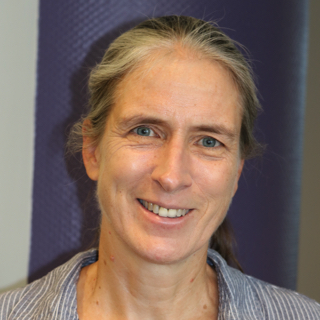
Cynthia Peters is the editor of The Change Agent magazine, an adult education teacher, and a nationally known professional development provider. She creates social-justice-oriented materials that feature student voices, along with standards-aligned, classroom-ready activities that teach basic skills and civic engagement. As a professional development provider, Cynthia supports teachers to apply evidence-based strategies to improve student persistence and develop curriculum and program norms that promote racial equity. Cynthia has a BA in social thought and political economy from UMass/Amherst. She is a long-time editor, writer, and community organizer in Boston.




