


I write from Ladakh, where we are studying the impact of climate change and evolving participatory adaptation and disaster preparedness strategies with local communities.
The melting of snow in the Arctic and Antartic due to global warming and climate change is reported frequently. However, the melting of the Himalayan glaciers goes largely unreported, even though more people are impacted.
Presently 10% of the earth’s landmass is covered with snow, with 84.16% in the Antartic, 13.9% in Greenland, 0.77% in the Himalaya, 0.51% in North America, 0.37% in Africa, 0.15% in South America, 0.06% in Europe. Outside the polar region, Himalaya has the maximum concentration of glaciers. 9.04% of the Himalaya is covered with glaciers, with 30-40% additional area being covered with snow.
The glaciers of the Himalaya are the Third Pole. They feed the giant rivers of Asia, and support half of humanity.
In Ladakh, the northern most region of India, all life depends on snow. Ladakh is a high altitude desert with only 50mm of rainfall. Ladakh’s water comes from the snow melt – both the snow that falls on the land and provides the moisture for farming and pastures, as well as the snow of the glaciers that gently melts and feeds the streams that are the lifeline of the tiny settlements.
For centuries snow has supported human survival in Ladakh.
Climate change is changing this. Less snow is falling, so there is less moisture for growing crops. In village after village, we are witnessing the end of farming where snow melt on the fields was the only source of moisture.
Reduced snowfall also means less snow in glaciers, and less streamflow. The shorter period of snowfall prevents the snow from turning into hard ice crystals. Therefore more of the glacier is liable to melt when the summer comes.
Climate change has also led to rain, rather than snow, falling even at higher altitudes. This also accelerates the melting of glaciers.
Meantime, heavy rainfall which was unknown in the high altitude desert has become more frequent, causing flash floods, washing away homes and fields, trees and livestock. Climate refugees are already being created in the Himalaya in villages such as Rongjuk. As one of the displaced women said "when we see the black clouds, we feel afraid."
The arrival of black clouds and disappearance of white snow in the cold desert is how climate change is entering the life of the Ladakhi communities. They did not cause the pollution, but they are its victims. This is the direct and cruel face of climate injustice – the polluters continue to pollute, they are insulated from the impact of their own actions. Others, thousands of miles away bear the brunt of greenhouse gas pollution.
India has 5243 glaciers covering an area of 37579 km2 and containing 142.88 km2 of ice.
The Gangotri glacier, the source of the Ganga is receding at 20-23 miles per year. Millam glacier is receding at 30m/yr, Dokrani is retreating at 15-20m/yr. The receding of glaciers has accelerated with global warming. The rate of retreat of the gangotri glacier has tripled in the last three years. Some of the most devastating effects of glacial meltdown occures when glacial lakes overflow and the phenomena of Glacial Lake Outburst Floods (GLOFs) take place.
Climate change thus initially leads to widespread flooding, but over time, as the snow disappears there will be draught in the summer. In the Ganga, the loss of glacier meltdown would reduce July – September flows by two thirds, causing water shortages for 500 million people and 37 percent of India’s irrigated land.
Glacial runoff in the Himalayas is the largest source of fresh water for nothern India and provides more than half the water to the Ganga. Glacial runoff is also the source of the Indus, the Brahmaputra, the Mekong, the Irrawady and the Yellow and Yantze rivers.
According to the Intergovernmental Panel on Climate Change (IPCC), "glaciers in the Himayalas are receding faster than in any other part of the world and if the present rate continues, the likelihood of them disappearing by the year 2035 and perhaps sooner is very high if the earth keep getting warmer at the current rate". According to the IPCC report the total area of glaciers in the Himalaya will shrink from 193051 square miles to 38,000 square miles by 2035.
The lives of billions are at stake. That is why we have started a participatory process for Himalayan communities to engage in the discussion on climate change, including issues of climate justice, adaptation and disaster preparedness.
In terms of numbers of people impacted, climate change at the Third Pole is the most far reaching. And no climate change policy or treaty will be complete without including the Himalayan communities.
The Government of India has set up a National Climate Action Plan which has eight missions. One of the missions is for sustaining the Himalayan Ecosystem. However, the Himalayan communities are missing in the mission. As the Action Plan states "A mission for sustaining the Himalayan ecosystem will be launched to evolve management measures for sustaining and safeguarding the Himalayan glacier and mountain ecosystem. Himalayas, being the source of key perennial rives, the Mission would, inter-alia, seek to understand, whether and the extent to which, the Himalayan glaciers are in recession and how the problem could be addressed. This will require the joint effort of climatologists, glaciologists and other experts."
People only get introduced to protect forests "community based management of these ecosystems will be promoted with incentives to community organizations and panchayats for protection and enhancement of forested lands".
However climate change is about more than forests. It is about flash floods and draught, it is about planning for a future which is not like today. For this people need to be partners in monitoring and planning. No government machinery, no matter how sophisticated, can know every mountain, every glacier, every stream, and every field. People are experts on local ecosystems and the changes in their ecosystems due to a destabilized climate. It is this expertise which needs to be mobilized in order to evolve timely strategies for adaption.

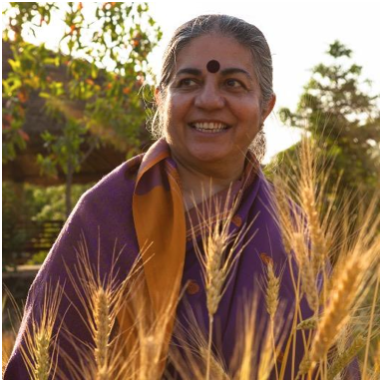
Vandana Shiva (born 5 November 1952) is an Indian scholar, environmental activist, food sovereignty advocate, ecofeminist, and anti-globalisation author. Based in Delhi, she has written more than 20 books. Shiva is one of the leaders and board members of the International Forum on Globalization, and a figure of the anti-globalisation movement. She has argued in favor of many traditional practices, as in her interview in the book Vedic Ecology (Ranchor Prime). She is a member of the scientific committee of the Fundacion IDEAS, Spain's Socialist Party's think tank, a member of the International Organization for a Participatory Society, and the founder of Navdanya, a movement for biodiversity conservation and farmers’ rights. She is also the founder and director of the Research Foundation for Science, Technology and Natural Resource Policy. Shiva fights for changes in the practice and paradigms of agriculture and food. She received the Right Livelihood Award in 1993, an award established by Swedish-German philanthropist Jakob von Uexkull, and regarded as an "Alternative Nobel Prize”.




