|
Looking
Forward. By Michael
Albert and Robin Hahnel 7. Workplace
Decision Making
|
|
|
|
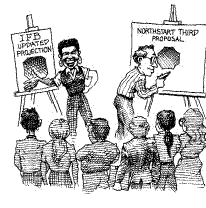
The Third Planning Iteration
After Nancy
and everyone else submit second proposals, lFBs again adjust indicative
prices, update their own projections, send relevant summary reports to all units,
and store all this information in the planning data bank. The new wrinkle is
that in addition to industry IFB reports on industry proposals and averages,
there are also industry IFB projections for likely final industry plans, as
well as suggestions to member units regarding how they might best move toward
these likely final outcomes. In instances where a unit diverges dramatically
from industry averages, discussions may commence between that plant's board
and lFBs to explore the reasons for the differences. In going over
new data and considering how to alter proposals for goods in over-demand or,
less often, over-supply, in line with the hypothetical rules used as an example in chapters 5 and 6, and since
labor reallocations to and from Northstart are already largely settled, Nancy
can now only alter her proposals for particular items that Northstart would
use or produce by less than 50 percent if she wants to move them in the
direction that equilibrates supply and demand, and by less than 25 percent if
her proposed change is disequilibrating. And this rule applies as well for
developing proposals numbers four through six, discussed below. Preparing her
third proposal, however, also involves Nancy in many more discussions with
work mates. While each Northstart worker still makes his or her own proposals
for all of Northstart, unlike in earlier rounds they incorporate
modifications arising from collective discussion. Thus, one day of meetings
in work groups and departments is set aside for discussions of proposals.
Like many other details in this discussion, the rules for changing proposals
for each new iteration and for carrying out planning within workplaces seem
reasonable to us (particularly in societies in which there is considerable
friction moving resources from one use to another), but still, these are only
possible choices included to
describe one plausible implementation. The Fourth, Fifth, and Sixth Planning Iterations
Now, Nancy
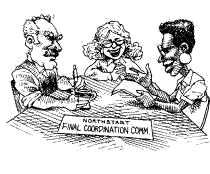
and her coworkers confront a new challenge: Their fourth proposals will be
made not separately but together. The different ideas of Northstart workers
must finally be combined into one consistent Northstart proposal. It isn't
necessary for each individual's role in the proposal to be spelled out since
assignments are irrelevant to the rest of the economy. But workers' councils
proposals do need to be implementable. So, although the same limitations on
adjustments apply as for the third proposal, now they apply to the single, new Northstart proposal. The formulation
of the fourth proposal requires various sessions held intermittently over a
full week, though it is certainly not full-time work so that other work also
continues. Mainly, a week allows sufficient time for thinking before plant
members choose a new proposal. First the
smallest work groups meet and members compare their individual proposals
hoping to accommodate them with one another. These meetings serve primarily
as a warm-up for more important department and area meetings to come. Here's how it
might work. Nancy has a small group meeting on Monday of
"fourth-proposal week." On Tuesday she meets with the editorial
department to talk about numbers of titles and readership to try to reach
agreement on these matters. On Wednesday, she has a similar meeting with the
promotion department, the site of her non-editorial, non-production work.
Throughout Northstart, others hold similar meetings, and the Northstart lFB
summarizes and distributes each day's results. Monday's meeting is limited to
an hour. But those on Tuesday and Wednesday run for an hour and a half in the
early morning and then for another hour and a half near the end of the day.
In its meeting, Nancy's editorial group begins by listing the number of new
Northstart titles each member prefers to undertake, the readership they
anticipate, and the mix of different kinds of titles they desire. Debate
commences regarding the difference between initial averages of proposals and
current consumer demands and projected industry averages. Since each
editorial group meets separately, the Northstart IFB reports each group's
results as well as an average for them all. The following day Nancy's
promotion group starts with the overall average as a premise and suggests its
own adaptations in light of promotion needs and potentials. Because all
departments do this on Wednesday, there emerges a new average to be
considered Thursday. Finally, a council meeting all day Friday functions
somewhat like a senate, considering amendments to the average from the floor
as a means of developing competing alternatives, and finally voting for one
proposal as Northstart's proposal for the fourth iteration. One important
feature of this process would be an effort to accommodate competing
perspectives in the form of compromises or experiments. This would allow
minorities to present practical evidence of the virtues of their position.
The fifth and sixth iterations would proceed like the fourth, but with each
taking much less time and incorporating tighter limits on the allowed
percentage changes in inputs and outputs. And, of course, for each new
proposal there would be new information about the status of goods, average
outputs, and indicative prices, all of which would provide pressures to move
toward a feasible plan. The Seventh Planning Iteration
After
receiving the sixth proposals from production and consumption units, industry
and national IFBs have a new task: they must consider available data and
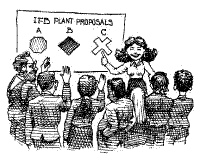
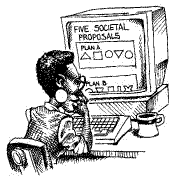
offer five feasible plans for society to choose among. Since we will discuss
IFBs more when we focus on the intricacies of allocation in chapter 9, here
we simply assume they do their task well and present society with five
proposals. But we should mention that IFB worksheets and minutes of their
meetings are available to anyone through computer access. This is to provide
units with more information, should they want it, and also to guard against
potential IFB manipulation. Obviously,
the choice of five plans-like many other details of the process we are
describing--could be varied without changing the underlying logic of
participatory planning There could be fewer individual iterations or more
collective ones, or limitations on adjustments or submission of council-wide
rather than individual proposals could begin earlier or later, and, in a real
society such refinements would evolve in accord with particular economic,
cultural, and social histories, since once citizens agree that participatory
planning has potential, they will modify the system to suit themselves. In any event,
in our hypothetical scenario, after a period for discussion and thought,
everyone would vote for one of the five proposed plans. The votes would be
tallied in each council, submitted to higher level federations as sublevel
totals and tallied again, and so on until final results were available-likely
within a couple of hours. The two proposals that receive least votes in the
first ballot are dropped. IFBs amend the remaining three proposals in light
of the relative weight of votes. A second ballot eliminates the least popular
of the three. and then the two remaining choices are slightly amended, a
final choice is made, and the chosen option becomes the seventh aggregated projection of the iteration
process. IFBs then use this projection to calculate expected indicative
prices, total economic product, growth rate, average work and consumption,
and outputs for individual goods, all of which are sent to the plan data
bank. Nancy and
other members of Northstart (and all other economic units) now accept the
projections for society's total product, average work load, average
consumption allowance, and average work complex quality as benchmarks. All
further revisions are confined to adjustments of responsibilities within
federations and units in light of the overall plan. |
|
|