|
Looking Forward. By Michael Albert and Robin Hahnel
5. Allocation Without Hierarchy |
|
|
The great are great only because we are on our knees. Let us rise! -Max Stirner The Ego and His Own
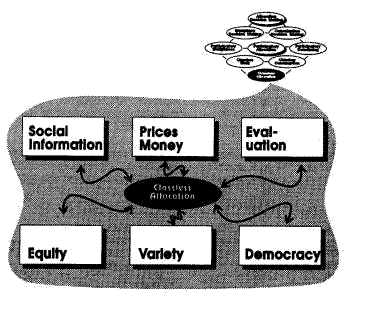
"Indicative prices in the sense that they indicate the social costs and benefits of things as accurately as we can, and accounting money to emphasize that money is only a measuring tool."
Can I see another's woe, And not be in sorrow too? Can I see another's grief, And not seek for kind relief? -William Blake On Another's Sorrow
Toleration is not the opposite of in toleration, but is the counterfeit of it. Both are despotisms. The one assumes to itself the right of withholding liberty of conscience, and the other of granting it. The one is Pope armed with fire and fagot, and the other is the Pope selling or granting indulgences. -Thomas Paine The Rights of Man
"Participatory economics does not rule out some people working harder to consume more or consuming more because of special approved needs. But participatory economics does rule out some people consuming more than others without working more or having special needs."
|
Measuring
Work Expended
We have said we want workers to be able to overwork to make above-average purchases or to make below-average purchases and underwork. In an earlier chapter, we also clarified that we did not want class differences to evolve between people doing work complexes with markedly different effects. We urged that whenever a plant had above-average conditions, its workers would spend some time doing more menial tasks elsewhere, and that whenever a plant had below-average conditions the workers would spend time in more interesting pursuits elsewhere. The idea was that everybody's work be balanced regarding demands and rewards even while differing in particular characteristics.
In this context, for an individual to work nonaverage hours in a given period and not disrupt a humane balance of job complexes, he or she could diminish or increase his or her hours worked at all tasks in the same proportion. Each individual could then receive from his or her workplace an indicator of average labor hours expended as an accurate indicator of work effort contributed. Over a sufficient period, whenever a person's indicator was high (low) compared to the social average, the individual would have contributed more (less) to the social product and would be entitled to ask for more (less) consumption now or at some later date. Accounting money income thus equates to real socially average labor hours
It is critical to realize that unlike in any other kind of economy, since job balancing actually occurs in our system, socially average hours are a real and measurable concept in a participatory economy. We should also remember that in a participatory economy one's consumption depends not only on one's work effort but also on one's needs. If you request above-average consumption because of some ailment or personal project approved by your neighborhood council and producers, you don't necessarily have to work more or borrow to receive it. Work expended plays a pivotal role, however, when a person wants to consume above average in ways others would not OK. Participatory economics does not rule out some people working harder to consume more nor consuming more because of special approved needs. But participatory economics does rule out some people consuming more than others without working more or having special needs.
Still, what enables people to understand the details of one another's situations, as we have said they will?
Qualitative Description
We have said we would like producers to respect the needs and desires of the people they produce for and consumers to respect the sacrifices of the people who produce what they consume. To facilitate this, we certainly want economic actors to have easy access to indicative prices summarizing large amounts of information. But these prices should only be facilitators.
However odd it may initially appear, what participatory economics requires to prevent reductionist accounting is for each actor to have access to a list of everything that goes into producing goods she or he consumes, and everything that results from the goods she or he produces. Of course, not all of this vast store of qualitative information will be used by every worker and consumer in every decision-there would be too much even to read. But we contend that over time people will become familiar with the "congealed components" of products they regularly use, just as they are now familiar with the products themselves. Then, whenever consumers ask producers to meet a high demand, or producers ask consumers to lower demands so that workers can enjoy a more leisurely work life, each party will be able to consider the qualitative dimensions of the other's requests.
For example, as a worker, if I am considering improving the quality of work, I need to know what dislocations any reorganization will cause consumers so I can weigh their discomfort against my gains. As a consumer, I need to know the human costs of producing the goods I desire so as to be able to weigh the benefit to me against the costs to others. Do I want to back off and lower my request, or do I want to maintain it and argue that either workers should produce more or someone else should cut their demand?
If an individual seeks an unusually expensive consumption bundle, he or she will have to justify the request to his or her consumption council to have it OK'd as part of the council's proposal. If the council's request is above the per capita average and producers balk at producing more, the council must decide whether to lower its request in the next planning round, or to hold out in expectation that other councils will lower their requests or that workers will offer to raise production. To make these types of decisions, both producers and consumers must have ready access not only to summary price data, but to detailed qualitative accounts. Only this will ensure that the human and social dimension of economic decision making isn't lost and thereby guarantee that summary price data remains accurate.
Still, suppose I want to consume more computers. The computer factory uses chips made at a chip factory, which in turn uses machinery made at a machine factory. Do I have to know all this information-the impact of my request on all these factories? To see, we have to examine the role of various allocation institutions in chapter 6. Then we will be able to see how information would actually be used and decisions made in some hypothetical workplaces and living units in chapters 7 and 8.
|

|
|